AI sales prospecting should stop the moment public evidence cannot support a specific owner-facing action. Producing more copy at that point creates fiction with citations.
We found that failure inside BrandLab during internal development. Raw public observations were being turned into invented business problems and generic fixes. A captured sentence could enter the system as evidence, then leave as a confident diagnosis the evidence never established.
The repair removed fallback issue invention and made incomplete research fail closed. Missing diagnosis, unsupported impact, generic repair, absent pass check, unverified recency, and a missing public outreach route now block the owner-facing plan.
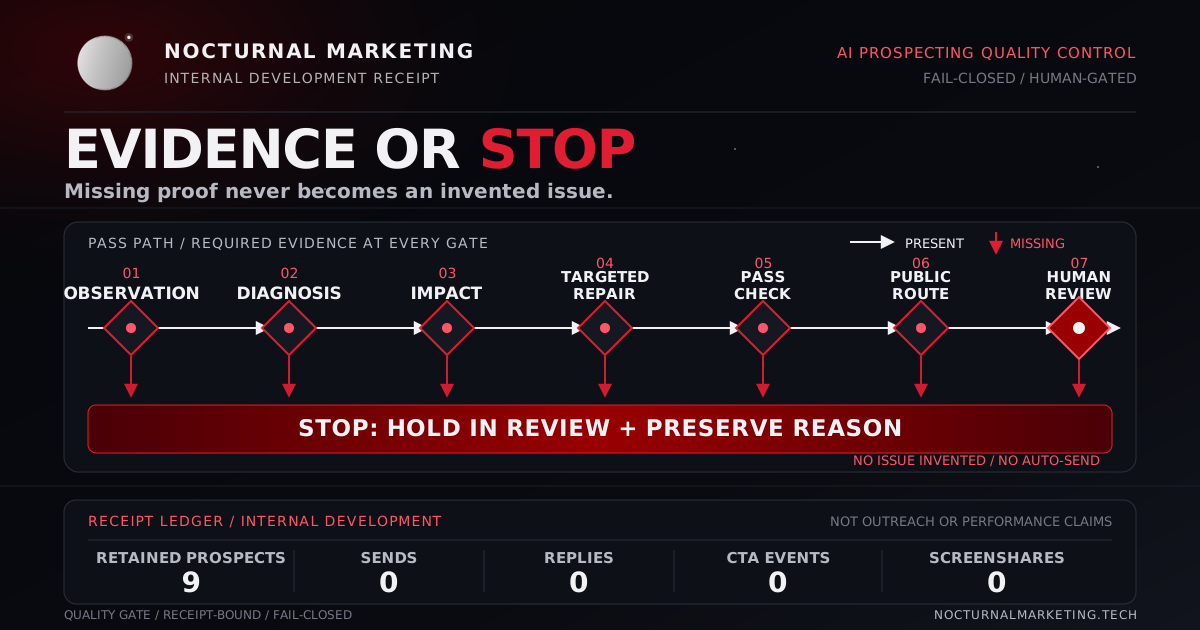
Proof scope: Internal BrandLab development ledger checked July 28, 2026. Nine records remained research-qualified. Sends, replies, CTA events, and screenshares all remained zero.
The failure a polished draft hid
The weak output looked researched. It included a public URL, a captured span, owner-facing language, and a proposed free fix. Those details gave the draft the shape of responsible AI sales prospecting.
The logic underneath was thin. When the system lacked a verified diagnosis, a fallback assembled one from whatever text had been captured. An article title, role description, event schedule, product announcement, or stock notice could be reframed as a customer problem. The proposed repair then used a reusable instruction such as "add the source" or "rewrite the sentence."
Swapping the URL and quote made the same recommendation fit another business. That is the tell. The output was personalized at the token level while remaining generic at the decision level.
A smooth model response made the defect harder to see. The copy had complete sentences and plausible consequences. A busy reviewer could read the intended meaning into it because they already knew the prospecting doctrine. The owner receiving the message would see an unsupported problem and a vague task.
This is where AI prospecting quality control earns its place. The gate has to judge relationships between evidence, diagnosis, impact, repair, completion, timing, and outreach readiness. Field presence alone cannot do that work.
The invariant behind the repair
The repaired workflow uses one governing rule:
An owner-facing plan can advance only when current public evidence supports a specific diagnosis, a bounded impact, an executable repair, an observable pass check, and a valid public route for a low-friction ask.
Every part of that rule has an independent failure state. A high provider score cannot waive one. A valid URL cannot compensate for a missing diagnosis. A human-readable paragraph cannot rescue a generic repair.
When a required part fails, the research stays in review. The system suppresses client strategy, blocks outreach-ready inference, preserves the reason, and sends nothing. A queue with weak source material can correctly produce zero owner-facing plans.
That last behavior matters. Many AI sales prospecting products are optimized to fill every row. A governed system must be willing to leave a row incomplete.
Eight mechanisms that make the system stop
These eight mechanisms convert AI prospecting quality control from editorial advice into an operating boundary. Each one protects a different relationship in the prospect record.
1. Keep raw observations out of the issue field
A captured public span records what appeared on a named surface. It does not automatically establish a business defect.
The repaired provider can summarize raw evidence for internal review. It cannot manufacture an owner-facing issue or free fix from that capture alone. If the evidence does not support a diagnosis, the plan remains empty and the record stays in review.
This removes the fallback path that created the original failure. The system loses some apparent productivity because fewer rows look complete. It gains an honest distinction between collected evidence and usable research.
2. Require a diagnosis the evidence can establish
An observation must identify a specific gap on the public surface. Useful diagnoses include a conflicting count, a stale claim, missing support for a promise, unclear qualification language, or a mismatch between two public statements.
Restating the captured sentence fails. Writing that the page "may be inconsistent" fails too. The issue must explain what is wrong and show why the cited evidence establishes that conclusion.
This gate stops the system from asking an owner to investigate a problem the prospecting agent should have researched first. AI sales prospecting should reduce the owner's discovery burden. It should never hide unfinished research inside a confident recommendation.
3. Bind impact to a supported consequence
A diagnosis can be accurate while its claimed impact is invented. The quality gate checks that the consequence stays within what the evidence can reasonably support.
Customer confusion, buyer trust, visitor decisions, audience misunderstanding, and conflicting public results can be valid consequences when the diagnosed defect points there. Claims about lost revenue, legal exposure, customer churn, or conversion decline need separate proof. The model receives no permission to fill that gap with likely-sounding language.
The stop condition is simple: when impact exceeds the evidence, hold the plan. A modest supported consequence is more useful than a dramatic unsupported one.
4. Reject generic repairs that survive a prospect swap
A usable repair names the public surface, the exact object to change, and the concrete action. Verbs such as open, replace, add, remove, compare, confirm, and correct create an executable instruction when they point to a specific diagnosed defect.
The swap test catches template repairs. Replace the prospect name, URL, and quote with material from an unrelated account. If the fix still reads as valid, the plan fails.
"Add the source or rewrite the sentence" was one of the weak patterns the repair blocked. A source URL beside a generic instruction still leaves the owner to perform the research. The AI sales prospecting system has to bring the marked location, the reason for the change, and a bounded correction.
5. Demand an observable pass check
Every proposed repair needs a finish line that another person can verify without reading the prompt history.
A pass check should begin with a completion condition such as "Done when" or "Pass when." It should name the visible result: the corrected sentence, supporting link, reconciled count, updated field, revised button, or removed contradiction.
Approval alone is insufficient because a reviewer can approve incomplete work. The pass check proves what changed on the public surface. When that condition is absent, the plan stops before outreach.
6. Verify recency before treating evidence as current
Public pages change. A captured statement can support a diagnosis on Monday and disappear by Friday. AI prospecting quality control needs an evidence timestamp and a fresh check before the finding reaches an owner-facing draft.
The system should stop when recency is unknown, the source no longer resolves, the captured span has changed, or newer public material contradicts the original finding. A stale observation can remain in the audit history while losing its authority over the next action.
This is an operational cost. Rechecking sources takes time and can reduce queue volume. It also prevents the team from contacting an owner about a defect they already fixed.
7. Require a public outreach route and a low-friction ask
A retained prospect can have strong research and still lack a verified public route for contact. The workflow should never turn that gap into permission to search private data, guess an address, or infer that a send is ready.
The route must come from an allowed public surface and fit the approved outreach policy. The ask should offer work the research already produced, such as a marked sentence, page links, a bounded rewrite, or a short proof packet. It should give the owner one easy question to answer without requiring a meeting.
When the route is missing, the research may remain useful internally. Outreach readiness stays blocked. This separates prospect quality from contact availability and preserves human approval over the final recipient, message, timing, and send.
8. Keep prospect retention separate from buyer activity
The outcome ledger is the final quality mechanism. It prevents internal preparation from being reported as market response.
A retained prospect means the record survived the source and qualification checks used for that recovery. It says nothing about contact, interest, or sales performance. Sends, replies, CTA events, and screenshares require their own recorded events.
The recovered ledger contained nine retained prospects. It explicitly recorded zero sends, zero replies, zero CTA events, and zero screenshares. Those zeros protect the truth of the case. They also block any claim that the repaired workflow improved response, meetings, pipeline, or revenue.
What the recovered ledger proves
The nine retained records prove that the recovery preserved a small, source-backed prospect set under the revised controls. They do not prove that the prospects agreed with the diagnosis, saw an offer, or took any action.
The zero activity counts are part of the result. They show that research recovery and external outreach stayed separate. Nocturnal can inspect the quality gate without turning internal development into a disguised campaign case study.
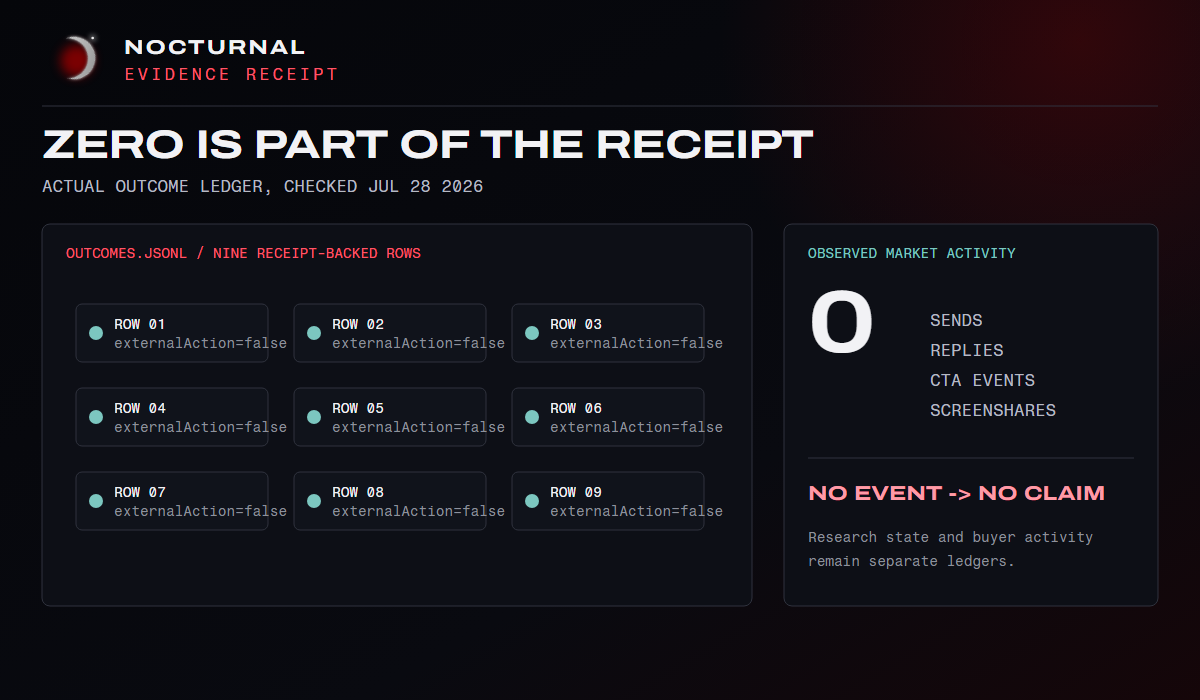
Evidence receipt: The visual reproduces the current outcomes.jsonl contract. Nine rows parse, and every externalActionOccurred field is false. The exact outcomes-ledger SHA-256 is embedded in the SVG.
That distinction also improves future measurement. If an approved outreach test happens later, its sends and downstream events can begin from zero instead of inheriting imagined history.
Five checks buyers can run
A buyer evaluating an AI sales prospecting product should ask for a controlled demonstration with messy evidence. Five checks expose whether the system values throughput over truth.
| Check | How to run it | Pass condition |
|---|---|---|
| Observation and diagnosis | Give the system a real public sentence that contains no established defect. | It stores the observation and returns no owner-facing diagnosis. |
| Prospect swap | Move the proposed repair to an unrelated prospect after changing only the URL and quote. | The repair becomes invalid because it depends on the original defect. |
| Recency replay | Change or remove the source after the first capture, then rerun the record. | The old finding loses outreach authority and returns to review. |
| Outreach route removal | Remove the approved public contact route from a qualified record. | Prospect retention can remain while outreach readiness becomes blocked. |
| Outcome truth | Ask for separate counts for retained prospects, sends, replies, CTA events, and screenshares. | Missing events stay zero or explicitly unknown without inferred buyer activity. |
Run all five before approving a pilot. A product that can generate impressive personalization but cannot demonstrate the stop path has shown only the happy path.
How this changes AI sales prospecting
Volume is easy to demo. Quality is visible when the system refuses to complete a row.
The repaired workflow moves the model into a narrower role. It can gather public evidence, compare claims, structure research, draft a supported plan, and prepare a low-friction ask. Deterministic checks decide whether the required relationships hold. A person approves the final recipient, message, timing, and send action.
This division gives operators useful evidence at review time. They can see the source, diagnosed defect, bounded consequence, exact repair, pass condition, freshness, public route, and current outcome state. They can also see why a record stopped.
The review queue becomes more honest. Some prospects have usable research and no route. Some have a route and weak research. Some have current evidence but no supported impact. Those differences should survive into the interface and ledger instead of being compressed into a single score.
For message-level clarity after a plan passes, run the zero-context buyer test for AI sales emails. That check asks whether a buyer can understand the problem, work, deliverables, control, commercial terms, and next step from the message alone.
Approval and governance still sit outside the quality score
A strong prospect plan does not authorize outreach. The quality score answers whether the recommendation is supported and usable. Authorization answers whether this recipient, message, route, timing, and action can proceed.
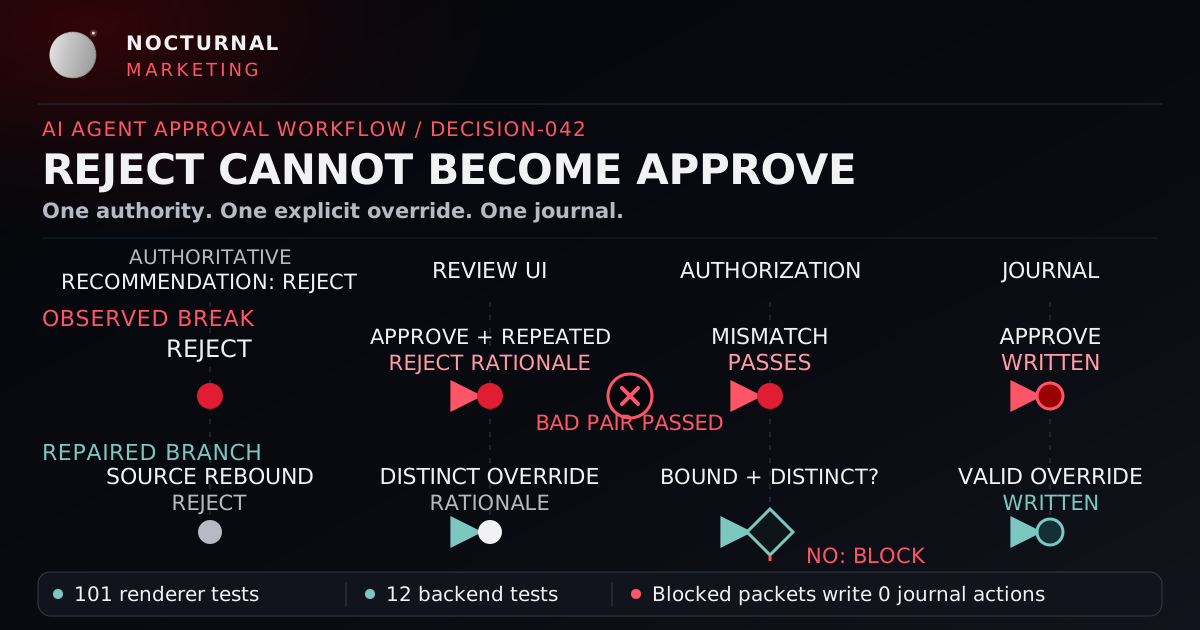
Our internal AI agent approval workflow failure shows how a Reject recommendation could be recorded as approval when recommendation, decision, and override were validated separately. The repair made recommendation authoritative and required a distinct, traceable override.
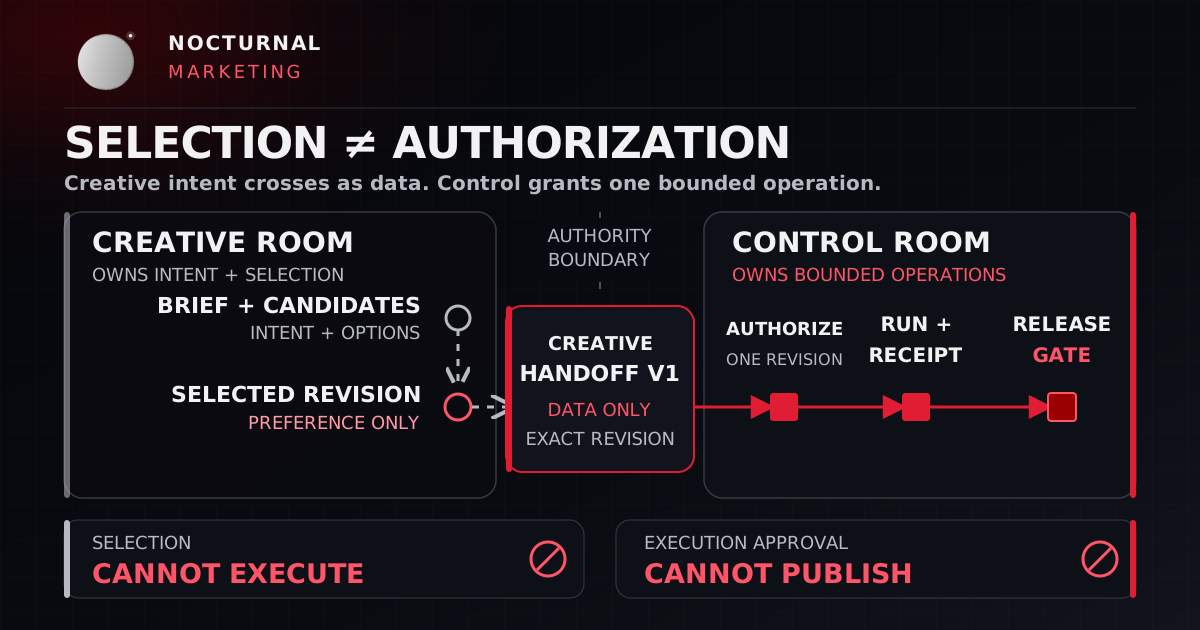
The AI agent governance architecture case covers the wider boundary between selecting a preferred output and authorizing a deterministic run. That separation matters in prospecting because a retained record, approved draft, and external send are three different states.
Together, these controls prevent a familiar failure chain: weak evidence becomes a plausible diagnosis, the draft looks complete, a selection looks approved, and an external action inherits authority nobody explicitly granted.
From quality gate to workflow repair
A failing prospecting gate often exposes a wider systems problem. The source collector, research provider, validation rules, persisted ledger, API projection, review interface, and send approval can each describe a different state.
The AI Agent Workflow Repair service hub is built for that class of contradiction. The repair is scoped and priced after diagnosis. It starts with one redacted record and traces it from evidence through diagnosis, review, durable state, and the blocked or approved action.
For an AI prospecting quality control problem, the work can include:
- reproducing the invented diagnosis or generic repair;
- defining the owner-facing invariant;
- adding adversarial evidence and prospect-swap tests;
- binding persisted plans back to their source evidence;
- separating prospect quality, outreach readiness, and buyer activity; and
- handing over the stop conditions, review notes, and acceptance tests.
The service stays focused on the narrowest boundary that can prevent the contradictory outcome. The goal is a workflow your team can inspect and operate after the repair.
What to measure after the quality gate
| Measure | What it reveals | Honest interpretation |
|---|---|---|
| Records returning zero owner-facing plans | Whether the system can refuse weak evidence | A quality result, not lost productivity |
| Generic repairs blocked by the prospect-swap test | Template leakage | Higher means the gate is catching weak output |
| Source rechecks that invalidate a finding | Evidence drift | Old observations correctly lose authority |
| Retained prospects with no public route | Separation of research quality and contact availability | Retained for research, blocked for outreach |
| Sends, replies, CTA events, and screenshares | Actual buyer activity | Stay zero or unknown until events occur |
BrandLab should preserve this separation in its ledgers and review surfaces. A prospect score, output judgment, or selected draft cannot create a send event.
Methodology and internal-development disclosure
This article documents an internal BrandLab development case reviewed on July 28, 2026. It describes a prospecting quality defect, the revised fail-closed contract, and the recovered ledger state.
We reviewed how raw public observations became owner-facing plans, then traced the plan through quality checks and persisted prospect outcomes. The repair removed deterministic fallback issue invention and added blockers for missing diagnosis, unsupported impact, generic repair, absent pass check, unverified recency, and a missing public outreach route.
The public case omits prospect identities, private data, internal source locations, hashes, and execution records. Examples are generalized so a reader can inspect the mechanism without reconstructing any account.
The recovered ledger had nine retained prospects and explicitly zero sends, replies, CTA events, and screenshares. No customer result, testimonial, response-rate lift, pipeline impact, or revenue outcome is claimed. Future outreach would require fresh source checks, a valid public route, message review, recipient approval, and a separate send authorization.
Frequently asked questions
AI prospecting quality control FAQ
Stop invented problems before outreach
Bring Nocturnal one redacted prospect record where the research looks complete but the owner-facing action feels wrong. We will trace the evidence, diagnosis, repair, pass check, recency, route, and outcome state, then scope the smallest useful repair.
Audit the Prospecting Gate