Why AI sales emails fail often comes down to one defect: the buyer cannot tell what is being offered.
We found that failure inside BrandLab while reviewing an outreach draft. V1 used source-backed personalization, preserved human approval, and stayed behind a send gate. It was still commercially useless. A buyer with no knowledge of our research or process could not explain the offer after reading the email.
We invalidated V1 before it reached anyone. Nothing was sent.
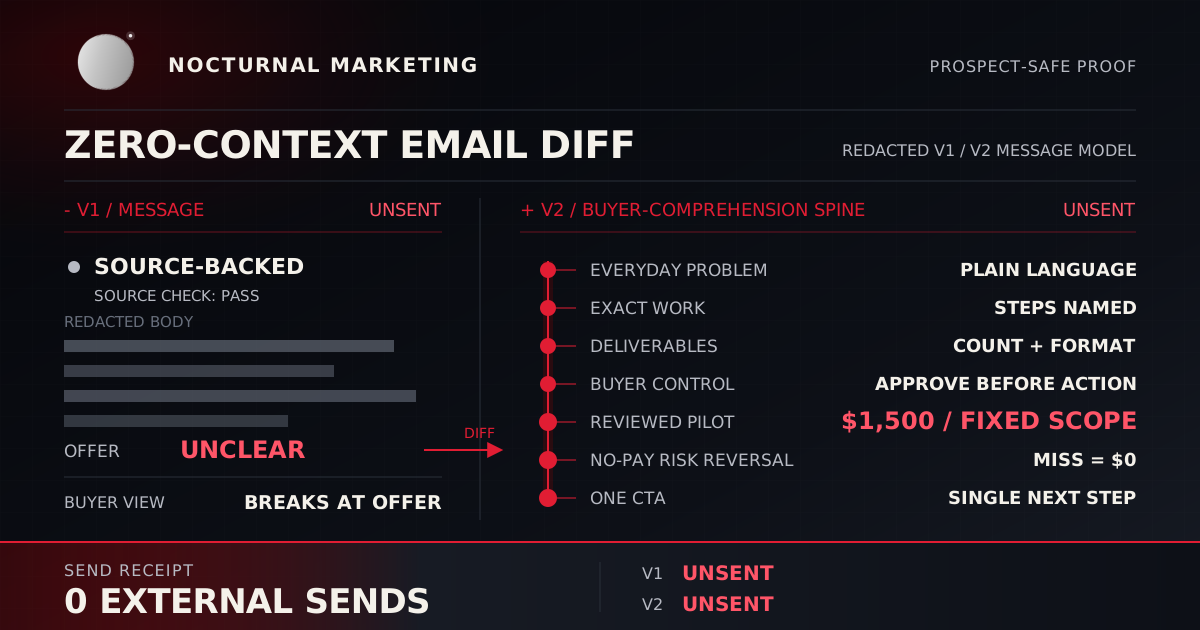
Proof scope: Internal BrandLab copy review checked July 28, 2026. The prospect and message text remain withheld. Both versions were unsent, so the evidence supports a comprehension repair without implying response or revenue results.
The expected invariant
The expected invariant was simple:
No outreach draft can advance to send-ready status unless a zero-context buyer can explain the problem, the work, the deliverables, their control, the commercial terms, and the next step.
An invariant is stronger than editorial advice. It is a condition the workflow must preserve every time. A polished sentence cannot compensate for a broken offer. A cited observation cannot compensate for missing scope. Human approval cannot rescue a message when the reviewer carries context the buyer will never see.
Our workflow already protected the send action. It did not yet protect buyer comprehension.
The failure inside V1
V1 had many of the controls teams are told to add to AI outreach:
- prospect observations came from reviewed source material
- personalization had an evidence trail
- unsupported claims were blocked
- a human had to review the draft
- the system could not send on its own
Those controls mattered. They prevented fabrication and unsupervised outreach. They also created a false sense of readiness because every check examined how the email was produced.
The email itself left basic commercial questions unanswered. The reader had to decode our language, infer the everyday business problem, guess what work we would perform, and imagine what they would receive. The message offered process intelligence when the buyer needed a concrete decision.
V1 met the workflow's existing governance checks. It failed as a sales email, so we invalidated it.
Why the checks missed the problem
The checks proved claim integrity, source discipline, permission boundaries, and human ownership. None measured whether a stranger could understand the offer.
Context made the review weaker. The people reviewing V1 already knew:
- what the source research meant
- why the observed weakness mattered
- what service we had in mind
- what the proposed pilot included
- where approval and payment boundaries sat
That knowledge filled every gap in the draft. The prospect would have received only the email.
This is a common review defect. The author reads the intended meaning while the buyer reads the words on the screen. AI makes the gap easier to miss because it produces smooth, credible prose. Fluency can hide missing commercial information.
Our AI agent handoff test checks owners, fallbacks, logs, and reject paths. The BrandLab case exposed another handoff: the move from internal evidence to buyer understanding.
The business consequence
V1 never reached a prospect, so it has no open, reply, meeting, or revenue result. Any claim about measured performance would be invented.
The commercial risk was still visible before sending. A confused buyer has to spend attention translating the seller's process. They cannot compare the offer, judge the commitment, or choose a next step. Source-backed personalization may prove that the sender did research, but research alone does not tell the recipient what to buy.
Had V1 been sent, the workflow could have produced a clean audit trail around a weak commercial event. That would protect governance while wasting buyer attention and sales capacity.
The cheapest time to catch that failure is before the email leaves the review queue.
The implemented repair in V2
We rebuilt the message around the buyer's decision. Prospect-specific wording remains private, but the repaired structure is safe to share.
| Buyer need | What V2 made explicit |
|---|---|
| Everyday problem | The email translated the observed issue into a problem the buyer deals with in ordinary business language. |
| Exact work | It stated what we would do during the pilot instead of asking the buyer to interpret our process. |
| Deliverables | It named the concrete outputs the buyer would receive. |
| Buyer control | It explained which decisions and approvals stayed with the buyer. |
| Price | It gave the pilot price: $1,500. |
| Risk reversal | It stated the no-pay condition if we failed to deliver the agreed pilot output. |
| Next step | It ended with one clear call to action. |
V2 translated internal system language into the information a buyer needs to make a small, controlled decision.
The buyer retained approval. The pilot had a fixed price. The no-pay condition reduced uncertainty around delivery. One call to action removed the need to choose among several vague next steps.
V2 replaced V1 inside the development workflow. It was not sent either.
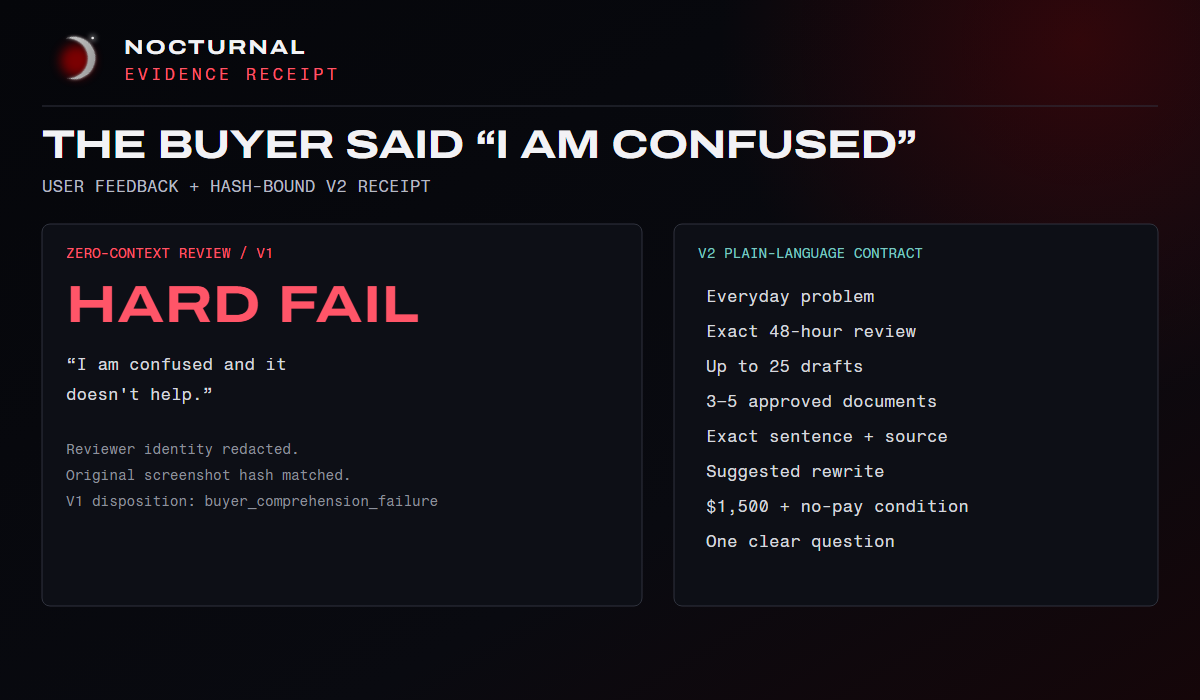
Evidence receipt: The reviewer name is removed. The quote, V1 hard-fail disposition, V2 requirements, and unsent states come from the hash-bound V2 receipt. The original feedback screenshot and V2 receipt hashes were verified during the internal review.
Run the adversarial zero-context test
A normal editor checks grammar, tone, evidence, and policy. The adversarial reviewer acts like a busy buyer who owes the sender nothing.
Give the reviewer only the subject line and email body. Do not provide the prospect research, service notes, prompt, source packet, workflow history, or an explanation from the author. Ask them to read once, without clicking a link, then answer the five diagnostic questions below.
The test passes only when all five answers are specific and consistent with the intended offer. "I think they mean" is a failure signal. So is an answer that depends on opening a calendar, downloading a deck, or replying for basic scope.
Use someone outside the drafting lane when possible. A reviewer who watched the email develop has already absorbed too much context.
The five-check buyer diagnostic
| Check | Ask the reviewer | Pass condition |
|---|---|---|
| 1. Problem | What everyday problem is the seller offering to solve? | The reviewer can state it in one plain sentence. |
| 2. Work | What exactly will the seller do? | The reviewer names the work without repeating vague capability language. |
| 3. Deliverables | What will the buyer receive? | The reviewer lists the concrete outputs promised in the email. |
| 4. Control and risk | What stays under buyer control, and when does the buyer owe nothing? | The reviewer identifies the approval boundary and risk reversal. |
| 5. Decision | What does the offer cost, and what single action comes next? | The reviewer gives the price and one call to action. |
Score each check as pass or fail. Do not average the result. A five-check email with one missing answer still forces the buyer to guess.
Put the test inside the sales system
The diagnostic works best as a workflow gate rather than a final copy tip.
A safe outreach path can use this sequence:
- Collect public, relevant source evidence.
- Draft personalization within approved claim boundaries.
- Verify each prospect-specific statement against its source.
- Give the email to a zero-context reviewer.
- Revise until all five buyer checks pass.
- Require a human to approve the final draft and recipient.
- Allow a send only through the approved sales process.
AI belongs in the support layer for evidence retrieval, drafting, memory, permissions, audit trails, and review preparation. A human owns durable business decisions and the final send.
This gate also needs a reject state. If the offer cannot be explained without unsupported assumptions, the draft returns for offer repair. If the source evidence is weak, the draft stops. If the recipient, timing, consent basis, or sending policy is unclear, the draft does not advance.
The same principle applies after a prospect responds. A good first email can still fail if the reply enters an unowned queue. Our website lead handoff guide shows how to trace that next stage from acceptance through human response.
The service bridge from copy to system
A failed buyer test often exposes more than awkward copy. It can reveal an offer the sales team cannot describe consistently, deliverables that change by conversation, pricing that appears late, or an approval boundary nobody owns.
Nocturnal Marketing can address that gap through a fixed-scope Systems Sprint. We map the current outreach path, translate the offer into buyer language, define the review and reject gates, build a usable diagnostic, and hand the operating process back to the team. The goal is a sales system that can explain its offer before it asks for attention.
The $1,500 price in this case belonged to the internal pilot offer under review. It is not a standing quote for every Nocturnal engagement. Current work is scoped through Nocturnal's services and a direct fit review.
What to measure after the buyer test
| Measure | What it reveals | Required boundary |
|---|---|---|
| Drafts passing all five checks on first review | Offer clarity before polishing | Does not authorize send |
| Revisions required by zero-context reviewers | Hidden context inside the drafting team | Record the failed question, not a vague quality score |
| Approved recipients and messages | Human ownership of the external action | Bind approval to exact bytes and route |
| Sends | Actual campaign activity | Zero until a send receipt exists |
| Replies, meetings, and revenue | Buyer response and commercial outcome | Never infer from draft quality or source receipts |
For the content itself, monitor GSC impressions and query mix for why AI sales emails fail, then compare GA4 engagement and service-page clicks. Search engagement validates the article's usefulness. It does not validate V2's sales performance.
Methodology and internal-development disclosure
This article documents an internal BrandLab development and quality-control case. It is not client work. The case was reviewed on July 28, 2026, before any external outreach occurred.
"Source-backed" means prospect-specific observations in the draft were tied to reviewed source material. It does not mean the prospect endorsed the analysis or the offer. We withheld the prospect's identity, the private evidence trail, and internal workflow details.
V1 and V2 are summarized here rather than reproduced verbatim. V1 was invalidated after the zero-context failure. V2 corrected the offer structure inside the development workflow. Neither version was sent.
Because nothing was sent, this case provides no evidence of higher open rates, reply rates, meetings, or revenue. It demonstrates an internal defect, a repair, and a stricter pre-send test. The $1,500 pilot price and no-pay condition describe that reviewed offer structure. They do not create a public guarantee or universal service price.
Frequently asked questions
AI sales email buyer test FAQ
Make the offer clear before you ask for attention
Bring Nocturnal an AI-assisted sales email, outreach workflow, or offer that keeps failing the buyer test. We will find the missing commercial context, define the pass condition, and scope the smallest useful repair.
Run the Zero-Context Test