Website redesign leads are easy to collect and expensive to misunderstand. An ordinary lead list can turn an old-looking homepage into a sales premise, skip evidence that the business is active, and treat a discovered route as permission to contact someone.
We tested a stricter qualification process on five public business records. It combined page captures, source-backed website weaknesses, SEO and answer-engine optimization (AEO) review, stack and hosting signals, plugin inspection, public activity checks, and sourced buyer routes. Four prospects survived. One business failed a nine-month activity rule. We recorded no outreach.
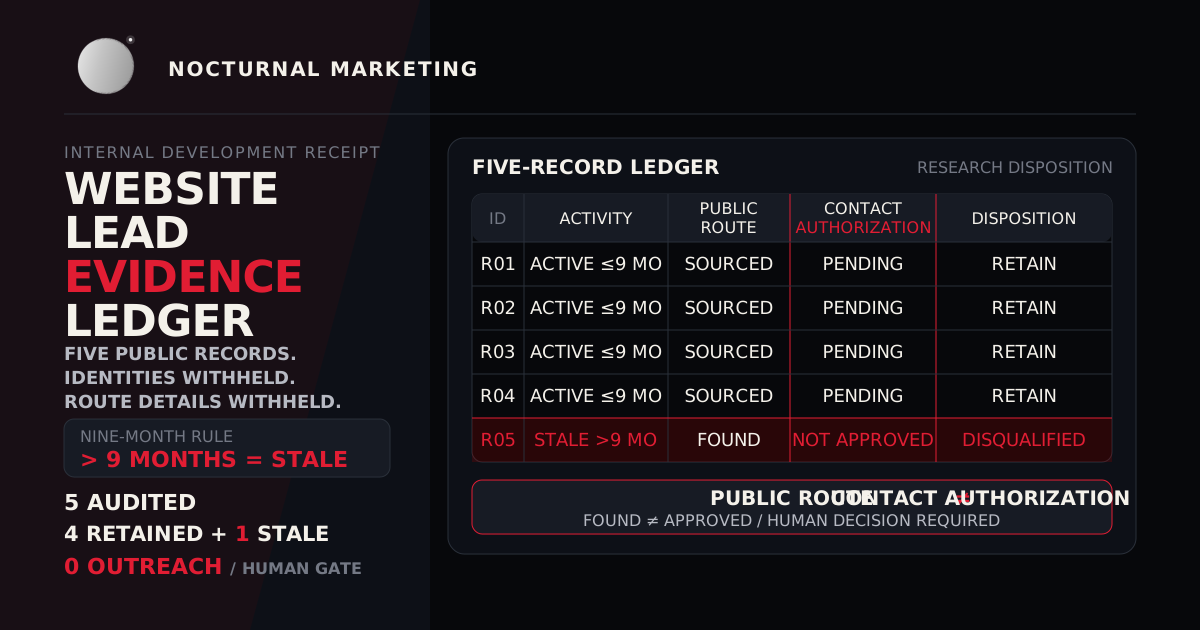
Proof scope: Internal qualification run checked July 28, 2026. Public identities and contact routes are withheld. The counts describe research disposition and zero outreach. They do not measure sales performance.
The expected invariant
Every qualified record should preserve one invariant from research through human review:
A website redesign lead stays qualified only when public evidence supports current activity, a page-specific website weakness, a plausible business consequence, relevant technical and search context, and a sourced buyer route with an explicit permission status.
Each part has a job. Activity evidence reduces the chance of researching a dormant business. Page evidence keeps the recommendation tied to something a buyer can inspect. Technical and search context prevents a cosmetic diagnosis when the deeper constraint sits in crawlability, content structure, hosting, or maintainability. A sourced route identifies a legitimate review path.
The permission status matters because route discovery is a research artifact. Contact authorization requires a separate human decision, applicable consent, and channel-specific rules.
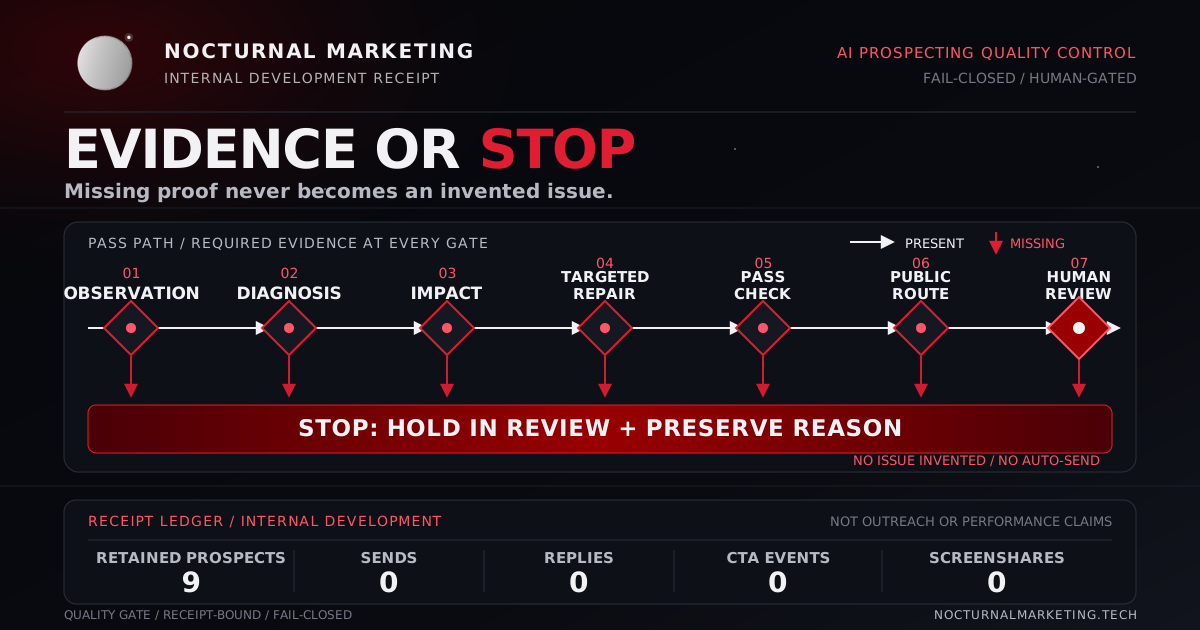
Our internal run enforced the invariant across all five records. Four retained evidence for every required field. The fifth had visible web assets but no public activity inside the nine-month window, so it left the list.
The failure hiding in ordinary lead lists
A common redesign list has four columns: business, URL, generic issue, and contact detail. The issue often says "dated website," "poor SEO," or "needs redesign." Those labels look useful until a reviewer asks for the page, capture time, source, buyer consequence, and freshness evidence.
The observed failure mode was evidence collapse. A row could be labeled qualified even when no reviewer could replay why.
The list may contain real businesses and valid URLs. It still fails as a decision system because its central recommendation cannot be replayed. A reviewer cannot tell whether the researcher saw a current page, a cached page, a directory listing, a technology-detection guess, or a personal preference about design.
Stale records make the problem worse. A directory can remain online long after a business stops updating its site and public profiles. The domain still resolves. The homepage still loads. A generic contact route still exists. Those signals can push a dormant record into an outreach queue unless freshness has its own gate.
Why common checks miss the failure
A homepage glance captures appearance while missing indexing, service-page structure, mobile action paths, schema, forms, and content depth. An SEO score can flag symptoms without showing whether the business is active or whether the issue matters to a buyer. A technology detector can identify likely platforms and exposed assets, but its output remains a clue that needs confirmation.
Contact databases create another blind spot. They optimize for finding a route, so a discovered email or profile can feel like completion. Qualification still needs role relevance, source quality, activity evidence, and human approval before contact.
Social recency also needs restraint. A recent post can support an activity check when the website carries no usable dates. It cannot prove budget, redesign intent, authority, or consent.
The business cost of weak qualification
A weak list consumes time twice. Researchers spend time decorating thin records with generic observations. Sales reviewers then reopen every source because the record cannot defend itself.
The recommendation can also be wrong. A visual refresh will not repair an abandoned operation. A platform migration may be excessive when one template or plugin causes the visible problem. An SEO pitch may miss the harder issue: the site gives search engines and answer engines too little source material to explain the business. A founder's public inbox may have no relationship to website ownership.
These errors create avoidable reputation risk. A stale or poorly sourced message tells the recipient that the sender did not inspect the business carefully. At scale, the same defect fills pipeline reports with records that were never ready for review.
Evidence changes the economics. Reviewers can approve, hold, or reject a record from the captured sources. Researchers can spend more time on the four records that survived and stop work on the one that failed.
The process we implemented
The qualification process used public evidence only and kept observation separate from recommendation. No client identities, private routes, or inferred personal details entered this article.
Qualify website redesign leads
Capture the page state
Name the website weakness
Check SEO and AEO
Inspect the delivery stack
Establish public recency
Source the buyer route
Adjudicate the record
This process did more than add research. It changed the unit of work. The deliverable became a reviewable qualification packet with page evidence, source links, timestamps, a weakness statement, system context, activity status, route provenance, and a final disposition.
The five-record run produced four passes and one rejection. The rejected business crossed the nine-month inactivity threshold after its undated website forced a social recency check. That rejection is useful evidence because the gate stopped a plausible-looking record before anyone wrote to it.
Adversarial reject cases
A qualification gate earns trust when it can reject records that look attractive at first glance. We used the following cases to pressure-test the process.
| Tempting signal | Adversarial evidence | Decision |
|---|---|---|
| The website looks dated | The observation has no captured page, timestamp, or buyer consequence | Hold until the weakness is reproducible |
| The domain and directory listing are live | No first-party or official public activity appears within nine months | Reject as stale |
| A detector reports an old CMS or plugin | Public page behavior and source evidence do not confirm a relevant weakness | Hold the technical claim |
| The site has thin search content | The business offer falls outside the service scope or shows no active operation | Reject for fit or activity |
| A public inbox exists | The source does not connect the route to a relevant role, and approval remains absent | Keep it outside outreach |
| A social profile posted recently | The website weakness is subjective or unsupported | Reject the redesign premise |
| A third-party source exposes a personal route | No first-party publication or legitimate business purpose supports its use | Exclude the route |
These reject cases prevent false confidence from entering the pipeline. They also keep stack data in its proper role. Public technical indicators can support a maintenance or performance hypothesis. They cannot establish vulnerability, ownership, or redesign intent by themselves.
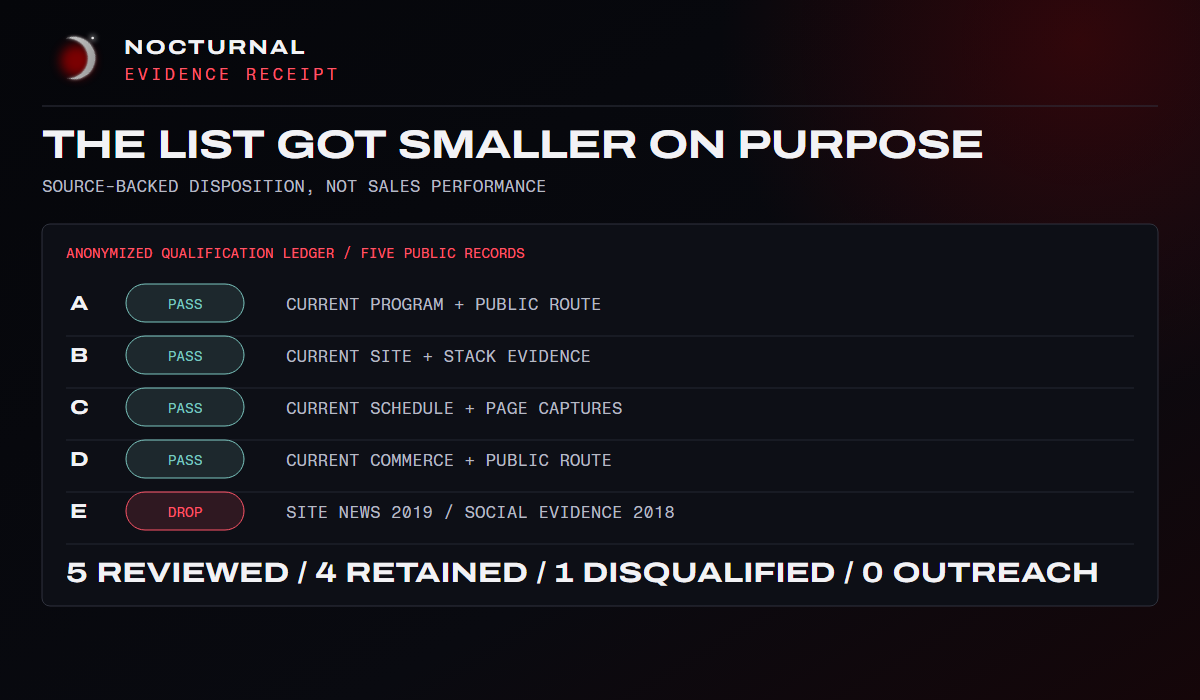
Evidence receipt: This redacted ledger reproduces the current five-record disposition without business names or routes. Its source hash is embedded in the SVG. The four retained records are research states. The zero-outreach count prevents them from being presented as sales results.
The five-check buyer diagnostic
Use this diagnostic before a website redesign lead reaches a sales review. Every check needs a visible pass.
1. Is the business publicly active
Pass when a first-party site, official profile, or other reliable public source shows activity inside the defined window. If the website has no dates, use public social recency as a fallback. Our working threshold was nine months.
2. Can another reviewer reproduce the weakness
Pass when the record includes an exact URL, page capture, timestamp, and precise observation. "Needs a modern website" fails because another reviewer cannot test it.
3. Does the weakness have a credible business consequence
Pass when the evidence connects to discovery, comprehension, trust, action, measurement, security, or maintainability. Keep the consequence proportional to the evidence. A missing service explanation can create buyer confusion. It does not prove lost revenue.
4. Did the review check the wider system
Pass when the record covers the relevant SEO/AEO, content, stack, hosting, CMS, plugin, mobile, and lead-path context. The goal is an accurate diagnosis, even when the best recommendation is a focused repair instead of a redesign.
5. Is the buyer route sourced and governed
Pass when a public source supports the route, the role is relevant, provenance is recorded, and authorization remains an explicit review field. Finding a route completes research. It does not approve contact.
A record with four passes and one unknown stays out of the approved list. This rule feels strict until the alternative is a queue full of confident guesses.
What the qualified system looks like
A controlled list is smaller and easier to trust. Each surviving record explains what was observed, where it appeared, when it was captured, why it matters, which technical signals support the diagnosis, how current the business appears, and where a relevant public buyer route came from.
The reviewer can challenge the evidence without repeating the entire search. A rejection remains useful because it records why work stopped. If the business becomes active later, a future reviewer can rerun the freshness gate rather than inherit an unexplained discard.
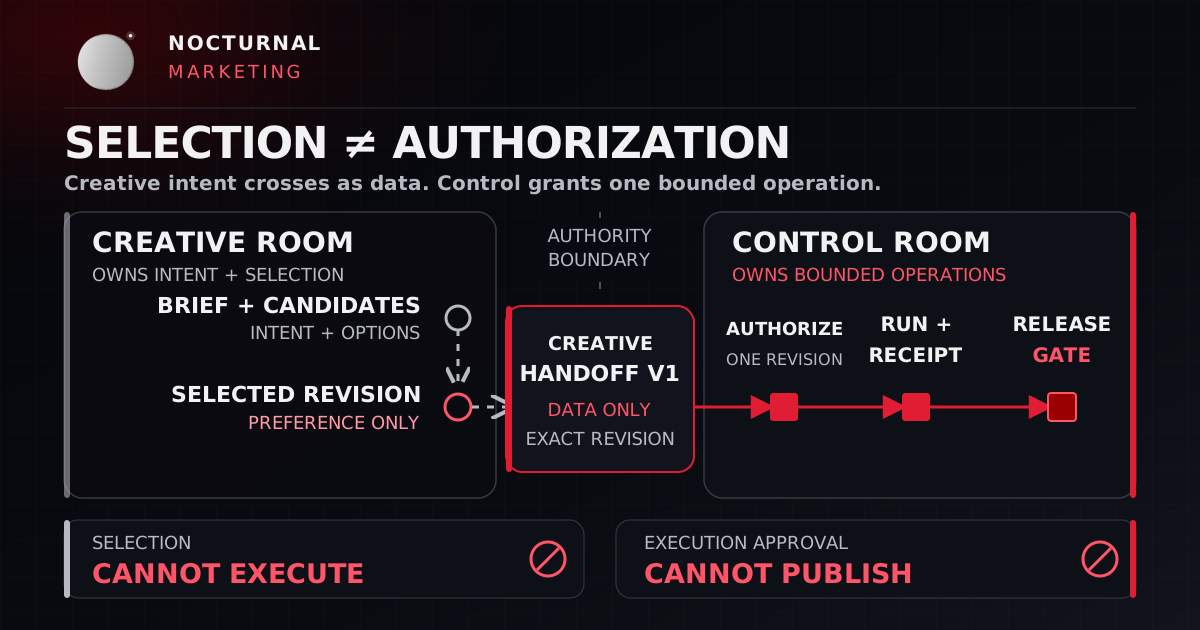
This approach also draws a clean line between research automation and human judgment. Software can capture pages, compare fields, inspect public stack signals, and flag missing evidence. A person should approve the weakness statement, business consequence, route use, and any outreach decision.
If your lead research workflow cannot preserve sources, reject cases, approval state, and replayable receipts, the underlying problem is larger than list building. Nocturnal's AI agent workflow repair service addresses that control layer when research or outreach automation has soft boundaries.
What to measure after qualification
| Measure | Why it matters | Keep separate from |
|---|---|---|
| Records reviewed, retained, held, and rejected | Shows whether the gate actually removes weak candidates | Sends and replies |
| Evidence fields complete at first review | Measures research quality | Lead volume |
| Records disqualified for stale activity | Prevents dormant businesses from inflating the queue | Website severity |
| Median human review time | Shows whether receipts reduce duplicate research | Outreach speed |
| Approved outreach actions | Marks the first external business action | Routes merely discovered |
After publication, use GSC to track impressions and qualified search queries for this article. Use GA4 to track visits from this article to /services or the workflow-repair page. Those content metrics still do not establish prospecting or sales performance.
Internal-development disclosure
This article documents an internal Nocturnal Marketing process under development. The five-record run tested qualification logic on public business information. The work involved no client engagement, paid campaign, or performance study.
The sample supports a process claim only: the evidence gate retained four records and disqualified one stale business under the stated rules. It does not support claims about response rate, conversion rate, revenue, or market-wide prevalence. We withheld business identities and route details. No outreach occurred.
Frequently asked questions
Website redesign lead qualification FAQ
Sources and methodology
- The internal method used direct public page observation, timestamped captures, page-source and response signals, public DNS or hosting indicators, exposed CMS or plugin asset paths, official public social timestamps, and first-party buyer-route sources. Technical indicators were treated as fallible clues and checked against visible behavior.
- Google Search Central's SEO Starter Guide supports the review of descriptive titles, useful page organization, crawlable links, and people-first content.
- Google Search Central's guidance for AI features supports using established SEO foundations, crawlable content, clear text, structured data that matches visible content, and accurate business information for search and generative AI experiences.
- Social recency was used only when website dates were absent. The same nine-month inactivity threshold applied across the five-record run.
- Public route discovery recorded source provenance for human review. Private routes, scraped personal details, client identities, and outreach actions were outside scope.
The process logged what could be observed from public sources at review time. Website content, social activity, DNS, hosting, plugins, and staff roles can change. Recheck every passing record before acting on it.
Bring evidence before outreach
Nocturnal Marketing builds governed website and workflow systems with source trails, reject gates, human review, and proof a team can replay. Start with the weak record, uncertain route, or qualification step your current process cannot defend.
See Evidence-Led Services